Data security is no longer just an IT responsibility. As AI, cloud adoption, insider risks, and compliance demands grow, businesses need a stronger data security strategy built on governance, accountability, and organization-wide ownership.
Zero Trust AI is a security model that applies continuous verification, least-privilege access, identity controls, and data governance to AI tools such as Microsoft Copilot. Its purpose is to help organizations use AI productively without exposing sensitive enterprise data.
AI is already inside the enterprise, whether security teams planned for it or not.
Employees are using AI across everyday workflows to move faster, write better, and get more done.
A spreadsheet is uploaded into an AI tool before a meeting. A proposal is drafted with a chatbot. A campaign report is analysed in seconds. These actions feel harmless, but they can expose customer data, financial information, intellectual property, and confidential strategy in a single prompt.
That is the new enterprise risk: AI adoption is accelerating faster than governance, permissions, and oversight can keep up.
What looks like a productivity shortcut can quickly become a security, compliance, and data governance problem.
This growing phenomenon is known as Shadow AI.
Unlike Shadow IT, where employees use unauthorized software, Shadow AI involves the unsanctioned or ungoverned use of artificial intelligence tools that interact directly with enterprise data. The challenge isn't necessarily malicious intent. It's a lack of visibility into what information is being shared, where it is being processed, and who ultimately has access to it.
At the same time, organizations are rapidly deploying enterprise AI solutions such as Microsoft Copilot to improve productivity and decision-making. While these tools offer significant business value, they also introduce a critical question:
How do you give employees the power of AI without giving AI unrestricted access to enterprise data?
The answer lies in Zero Trust AI.
By applying principles such as continuous verification, least-privilege access, identity-driven security, and real-time monitoring, organizations can embrace AI innovation while maintaining control over sensitive information. As AI becomes a workplace companion, this model is quickly becoming the foundation of secure AI adoption.
Why AI Adoption Is Outpacing Enterprise AI Security
AI adoption is accelerating faster than most security strategies were designed to handle.
According to Microsoft's 2024 Work Trend Index, 75% of knowledge workers globally are already using AI at work, demonstrating how rapidly AI has become embedded in daily operations.
The issue is not AI itself, but the fact that many security frameworks were built for a very different operating model.
Many organizations still rely on security models built for a world of manual access and assumed trust. AI changes that model.
Instead of searching across files, apps, and repositories, employees can ask one question and get a synthesized answer in seconds.
That boosts productivity, but it also magnifies the impact of weak permissions, poor governance, and excessive access.
A user who once had fragmented access to sensitive information can now surface and summarize it through a single AI interaction.
As AI becomes embedded in daily work, organizations need a security model designed for an environment where access, context, and data exposure can all be compressed into a single interaction.
What Is Zero Trust AI?
Zero Trust AI is the application of Zero Trust security principles to AI systems such as Microsoft Copilot. It ensures every AI interaction is governed by identity, access permissions, context, and data protection policies before information is retrieved, summarized, or shared.
The philosophy is straightforward:
Never Trust. Always Verify.
Instead of assuming trust once a user, device, or app is inside the environment, Zero Trust validates every request for access.
In a traditional environment, this means validating users and devices.
In an AI-powered environment, it means validating every interaction between users, AI systems, and enterprise data.
A mature Zero Trust AI framework includes:
· Identity verification
· Context-aware access control
· Least-privilege permissions
· Continuous monitoring
· Data protection policies
· Threat detection and response
In practice, this means AI can only access information a user is genuinely authorized to view.
For organizations deploying Microsoft Copilot, this approach is becoming essential for maintaining security, compliance, and trust.
Why Shadow AI Is a Business Risk
Many leaders assume AI risk begins when the business formally deploys an approved platform.
In reality, it often begins long before that.
Employees often experiment with AI tools on their own, creating blind spots that security teams cannot easily monitor or govern.
This creates several challenges:
Data Exposure
Employees may sometimes unknowingly share confidential information with external AI platforms.
Compliance Violations
Sensitive customer or employee data may be processed outside approved governance frameworks.
Intellectual Property Leakage
Proprietary information can be exposed through prompts, uploaded documents, or generated outputs.
Lack of Visibility
Security teams often have limited insight into which AI tools employees are using and what information is being shared.
Research from Microsoft shows employees are often more enthusiastic about AI adoption than organizational governance programmes can accommodate, creating a growing gap between usage and oversight.
Closing this gap requires a security model built on visibility, verification, and control.
How Zero Trust AI Secures Microsoft Copilot: Four Critical Security Layers
1. Identity Security for AI Access
Every AI interaction begins with identity.
If an attacker compromises an employee account, AI can quickly become a force multiplier for unauthorized access.
Strong Identity Security AI controls include:
· Multi-Factor Authentication (MFA)
· Conditional Access policies
· Privileged Access Management (PAM)
· Risk-based authentication
· Identity governance
Microsoft consistently identifies compromised identities as one of the most common entry points for security incidents.
By strengthening identity controls, organizations reduce the risk of unauthorized users leveraging AI to access sensitive information.
2. Least-Privilege AI Access Control
A finance executive, HR manager, and sales representative all require different levels of access.
Effective AI Access Control ensures that Microsoft Copilot only retrieves information aligned with a user's role, responsibilities, and permissions.
This principle of least privilege helps organizations:
· Reduce unnecessary data exposure
· Improve compliance
· Minimize insider risk
· Strengthen accountability
The goal is to make AI productive within existing security boundaries, not allow it to bypass them.
3. AI Data Protection and Governance
AI systems are only as secure as the data environment behind them.
Organizations must implement robust AI Data Protection practices to ensure sensitive information remains protected.
Key governance controls include:
· Data classification
· Sensitivity labels
· Information protection policies
· Data Loss Prevention (DLP)
· Data retention policies
McKinsey research shows that organizations are increasingly elevating AI governance and risk controls as they scale adoption, reinforcing that governance is a prerequisite for sustainable enterprise AI. Without governance, AI can unintentionally surface information that should remain restricted.
4. Continuous AI Monitoring and Threat Detection
Security is not a one-time configuration.
Organizations need visibility into how AI systems are being used across departments.
Continuous monitoring enables security teams to:
· Detect unusual behavior
· Identify policy violations
· Monitor sensitive data access
· Investigate suspicious activity
· Respond to emerging threats faster
For example, if an employee suddenly begins requesting large volumes of confidential information outside normal work patterns, security teams can investigate before a potential incident escalates.
This transforms security from reactive protection into proactive risk management.
Business Benefits of Zero Trust AI
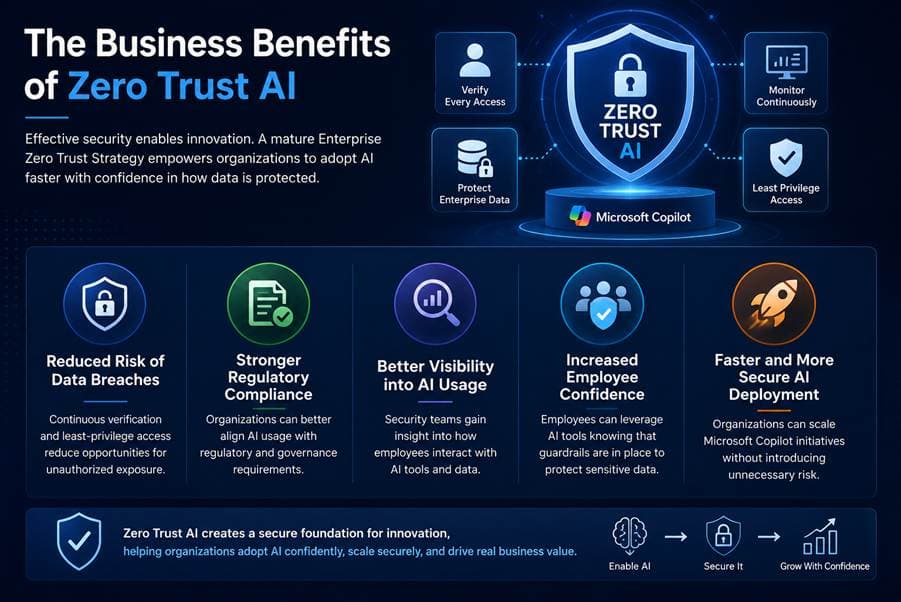
When Zero Trust principles are applied to AI, organizations do more than reduce risk. They create the conditions for confident adoption, faster scaling, and clearer accountability. Teams can use tools like Microsoft Copilot more effectively because access, governance, and monitoring are aligned with how sensitive business data should be used.
The result is fewer exposure risks, a stronger compliance posture, better visibility into AI usage, and greater confidence when scaling AI across the business.
Common Zero Trust AI Challenges and How to Solve Them
Implementing AI security is not without obstacles.
Many organizations struggle with:
- Overly broad permissions
- Shadow AI adoption
- Fragmented data environments
- Poor data classification
- Limited visibility into AI usage
The solution is not restricting AI entirely.
Organizations that attempt to block AI often find employees seeking alternative tools outside approved environments, creating even greater risk.
Instead, businesses should focus on:
- Establishing AI governance frameworks
- Conducting regular access reviews
- Classifying sensitive information
- Implementing identity-first security controls
- Continuously monitoring AI interactions
The goal is to enable innovation safely rather than prevent it.
H2 - Why Zero Trust AI Is the Future of Enterprise AI Security?
AI will be part of the future workplace, and for many organizations, it already is.
The question is no longer whether AI will be adopted, but whether it will be deployed with the right controls around identity, access, and data.
That is why Zero Trust AI is emerging as the security model for enterprise-scale adoption.
As Microsoft Copilot and other AI assistants become embedded in daily operations, organizations need a framework that protects identities, governs data access, and continuously monitors AI activity.
By combining Copilot security controls, role-based access, identity protection, and strong governance practices, businesses can expand AI use without expanding unnecessary risk.
The organizations that gain the most from AI will not just adopt it quickly. They will secure it deliberately.
That balance between innovation and control is what turns AI from a promising tool into a dependable business capability.
Frequently Asked Questions (FAQs):
1. What is Zero Trust AI?
Zero Trust AI is a security model that applies identity verification, least-privilege access, continuous monitoring, and data governance to AI systems. It helps ensure tools like Microsoft Copilot only access approved data.
2. How does Zero Trust AI protect Microsoft Copilot?
Zero Trust AI protects Microsoft Copilot by verifying identity, limiting data access, enforcing security policies, and monitoring AI activity. This helps reduce the risk of exposing sensitive enterprise data.
3. Why is Zero Trust AI important for enterprise data security?
Zero Trust AI is important because AI can quickly surface and summarize data across connected systems. Without strong controls, organizations face higher risks of data exposure, compliance failures, and unauthorized access.
Ready to Secure AI Without Slowing Innovation?
Microsoft Copilot can unlock significant productivity gains, but only when supported by the right security foundation.
At WinCap, we help organizations build secure, governance-led AI environments that support innovation without compromising control. From Microsoft Copilot adoption to identity security, access controls, and data governance, we help turn AI ambition into enterprise-ready execution.
Whether you're introducing AI in a single function or scaling it across the enterprise, a Zero Trust foundation helps you move faster with confidence, clarity, and control.
Explore WinCap’s AI Automation Services