Microsoft licensing has evolved beyond a procurement exercise. Choosing between Microsoft CSP and an Enterprise Agreement now influences cloud strategy, licensing costs, operational flexibility, and how quickly organizations can adopt new Microsoft technologies. This guide helps IT and procurement leaders evaluate both models with confidence.
For many organizations, Microsoft Licensing becomes strategic when a renewal, Azure expansion, Microsoft 365 growth, or Microsoft Copilot adoption changes how the business consumes technology. If your licensing needs are stable and predictable, an Enterprise Agreement may still provide useful structure. If your workforce, cloud usage, or Microsoft services are changing quickly, Microsoft CSP may offer better flexibility, ongoing optimization, and partner-led support.
Short answer: Microsoft CSP is usually better for organizations that need flexibility, monthly adjustments, partner support, and ongoing optimization. An Enterprise Agreement is usually better for large organizations with stable licensing needs, centralized procurement, and predictable multi-year requirements. The best model depends on usage volatility, cloud growth, support expectations, and renewal strategy.
In this Microsoft Licensing Guide, we'll compare Microsoft CSP and Enterprise Agreement across cost, flexibility, scalability, licence management, support, and long-term business value. Whether you're preparing for a renewal, expanding your Azure environment, or looking to optimise Microsoft 365 licensing, this guide will help you evaluate both models and make a more informed licensing decision.
- Best fit: Microsoft CSP suits changing cloud and workforce needs, while an Enterprise Agreement suits stable, predictable enterprise requirements.
- Flexibility: CSP offers higher subscription flexibility; an Enterprise Agreement provides a more structured commitment.
- Support model: CSP is partner-led with ongoing guidance and optimization; an Enterprise Agreement is more focused on centralized contract management.
- Cost control: CSP supports ongoing usage review and right-sizing; an Enterprise Agreement supports predictable multi-year planning.
- Risk: CSP needs active governance to avoid subscription sprawl, while an Enterprise Agreement can lock in unused capacity if requirements change.
Before choosing between the two licensing models, it helps to understand why so many organizations are reassessing their Microsoft licensing strategy in 2026.
Why Are More Organizations Re-Evaluating Microsoft Licensing in 2026?
Organizations are reassessing Microsoft licensing in 2026 because cloud consumption, AI adoption, hybrid work, and security requirements now change faster than traditional renewal cycles. A licensing model that worked three years ago may no longer provide the flexibility or cost control needed for Azure, Microsoft 365, Microsoft Copilot, Power Platform, and Microsoft security investments.
Several business trends are accelerating this reassessment:
- Cloud migration and hybrid infrastructure continue to replace traditional on-premises environments.
- AI-powered services such as Microsoft Copilot are introducing new licensing considerations.
- Organizations are expanding globally while managing distributed and hybrid workforces.
- Finance and procurement teams are placing greater emphasis on cost optimization and predictable technology spending.
- IT leaders are seeking licensing models that scale alongside business growth rather than restricting it.
That's why organizations are increasingly evaluating Microsoft CSP alongside traditional Enterprise Agreements instead of automatically renewing existing contracts.
What Is the Difference Between Microsoft CSP and an Enterprise Agreement?
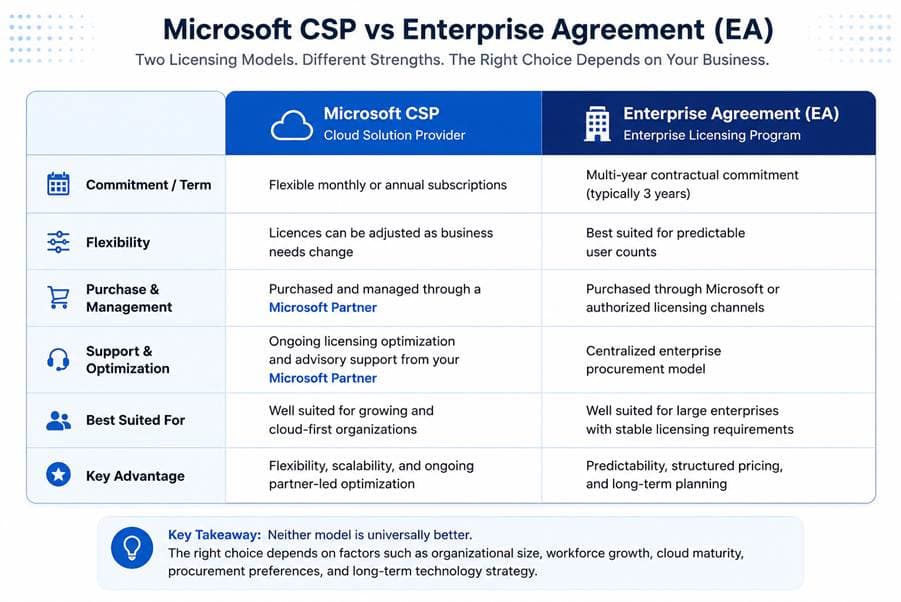
At a high level, both Microsoft CSP (Cloud Solution Provider) and Enterprise Agreements (EA) allow organizations to purchase Microsoft products and cloud services.
The main difference between Microsoft CSP and an Enterprise Agreement is how licences are bought, managed, adjusted, and supported. CSP gives organizations subscription flexibility and partner-led guidance. An Enterprise Agreement gives large organizations a structured, multi-year purchasing framework for predictable licensing requirements.
A Microsoft Enterprise Agreement is typically best suited to organizations that have stable licensing demands and prefer a structured, long-term purchasing model. It typically involves a multi-year contractual commitment that offers standardized pricing, centralized procurement, and long-term planning for organizations operating at enterprise scale.
A Microsoft Cloud Solution Provider (CSP) model offers a more flexible approach. Organizations purchase licences through an authorised Microsoft Partner, allowing them to add or remove subscriptions as business requirements evolve. Many CSP customers also benefit from licensing guidance, technical support, cloud advisory services, and regular usage reviews that help reduce unnecessary spend.
While both licensing models provide access to Microsoft's ecosystem, they are designed to support different business priorities.
When Does Microsoft CSP Make More Sense?
Microsoft CSP is increasingly attractive because it lets organizations align licensing with actual consumption. Businesses can adjust subscriptions, onboard new users, retire unused licences, expand cloud services, and work with a Microsoft Partner for ongoing guidance instead of waiting for the next renewal cycle.
CSP often delivers the greatest value when organizations need frequent licence adjustments, ongoing partner guidance, and a licensing model that can keep pace with cloud, workforce, and AI adoption changes.
A Smarter Way to Evaluate CSP
Instead of asking:
"Can Microsoft CSP reduce our licensing costs?"
Consider asking:
Will our workforce change over the next 12 to 24 months?
Do we expect Azure usage to increase?
Will we adopt Microsoft Copilot or additional Microsoft cloud services?
Would ongoing licensing guidance help us optimise our Microsoft investment?
If the answer to several of these questions is yes, the flexibility offered by CSP may provide significant operational and financial advantages.
Choosing Microsoft CSP makes sense for many modern organizations. However, that doesn't mean the traditional Enterprise Agreement has lost its relevance. For some businesses, its structure and predictability continue to provide considerable value.
When Is an Enterprise Agreement Still the Better Choice?
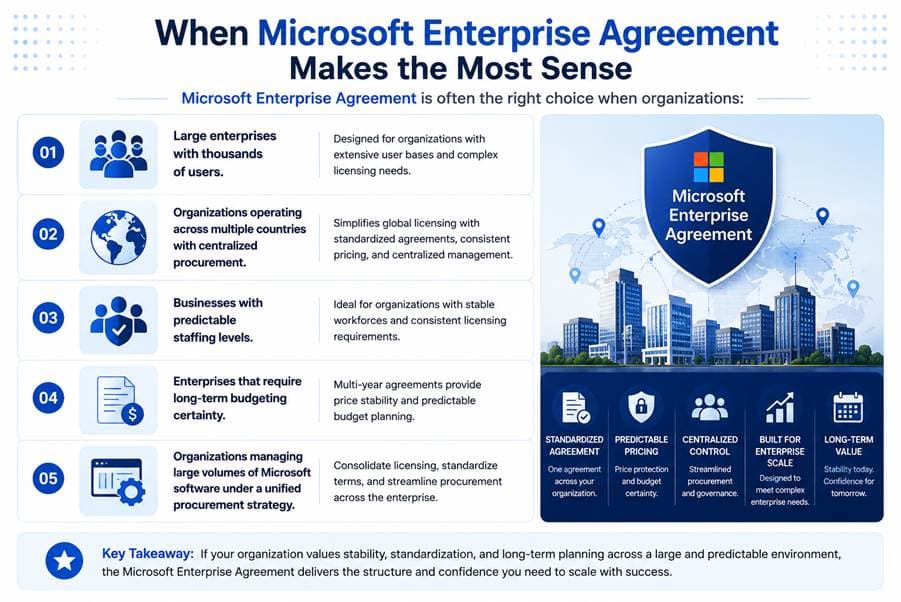
An Enterprise Agreement (EA) remains useful for organizations with stable workforces, predictable licensing requirements, centralized purchasing, and mature procurement processes. These businesses often value long-term planning and administrative consistency more than frequent subscription adjustments.
However, that predictability can reduce flexibility if workforce requirements change significantly, cloud adoption accelerates unexpectedly, or business priorities shift.
The decision therefore depends less on organization size alone and more on how frequently business requirements evolve.
Looking Beyond Contract Length
Rather than focusing solely on the duration of an agreement, organizations should evaluate whether their licensing model reflects the pace at which their business is evolving.
- A three-year agreement may provide certainty.
- A flexible licensing model may provide resilience.
The right choice depends on which of those outcomes delivers greater value to the business.
When Can a Hybrid Microsoft Licensing Approach Make Sense?
A hybrid approach can also make sense. Some organizations keep an Enterprise Agreement for stable, high-volume licensing while using CSP for changing cloud workloads, new Microsoft 365 services, Copilot adoption, or business units with variable demand. This approach can preserve procurement structure while creating flexibility where the business needs it most.
After comparing CSP and Enterprise Agreement, the next step is not simply choosing a contract type. Organizations also need to identify the licensing habits that create waste before any renewal or migration decision is made.
What Are the Most Common Microsoft Licensing Mistakes Organizations Make?
Even after choosing the right model, organizations can lose value through poor licence hygiene, outdated renewal habits, or limited visibility into actual Microsoft usage.
Some of the most common licensing mistakes include:
1. Renewing Existing Agreements Without Reviewing Usage
Renewal periods provide an opportunity to reassess how licences are being used across the organization.
Without analysing actual usage data, businesses may continue paying for subscriptions that no longer reflect operational needs.
2. Paying for Licences That Are No Longer Required
As employees change roles or leave the organization, inactive or underutilised licences can accumulate over time.
Regular licence reviews help eliminate unnecessary expenditure while ensuring users retain access to the services they genuinely require.
3. Treating Licensing as a Procurement Exercise Instead of a Business Strategy
Licensing decisions influence cloud adoption, AI readiness, cybersecurity, collaboration, and digital transformation.
When licensing is evaluated purely on contract pricing, organizations may overlook opportunities to improve operational efficiency and long-term business value.
4. Choosing a Licensing Model Based Only on Current Requirements
Business priorities rarely remain unchanged for several years.
Organizations planning acquisitions, workforce expansion, cloud migration, or AI adoption should evaluate whether their licensing model can support future growth instead of only current needs.
5. Managing Licensing Without Ongoing Expert Guidance
Microsoft regularly introduces new services, licensing updates, and commercial changes.
Working with an experienced Microsoft Solutions Partner helps organizations stay aligned with these changes while identifying opportunities for cost optimisation and licensing efficiency.
Once these common pitfalls have been addressed, the final step is choosing the licensing model that best aligns with the organization's business strategy rather than simply comparing features or pricing.
Explore Smarter Microsoft Licensing with WinCap
Choosing between Microsoft CSP and an Enterprise Agreement is only one part of the equation. The bigger opportunity is ensuring every Microsoft investment works together to reduce costs, strengthen security, improve productivity, and support long-term cloud growth.
As a Microsoft Solutions Partner, WinCap helps organizations move beyond licence procurement by aligning Microsoft Licensing with cloud, security, productivity, data, AI, and Microsoft Copilot priorities. Our team reviews licence usage, identifies optimisation opportunities, strengthens Microsoft cloud foundations, and supports ongoing environment management.
Before your next Microsoft renewal, WinCap can help you identify unused licences, right-size subscriptions, compare CSP and Enterprise Agreement options, and build a roadmap that supports cloud, security, AI, and productivity goals.
Schedule a Microsoft Licensing & Cloud Assessment
Frequently Asked Questions
1. Can an organization move from an Enterprise Agreement to Microsoft CSP?
Yes.
Organizations can move from an Enterprise Agreement to Microsoft CSP, but timing, eligibility, subscription terms, and renewal obligations should be reviewed carefully. A Microsoft Partner can help compare current agreements, avoid service disruption, and plan the transition around business, licensing, and cloud priorities.
2. Can a CSP partner help prepare for an Enterprise Agreement renewal?
Yes.
A Microsoft CSP partner can help organizations prepare for an Enterprise Agreement renewal by reviewing current usage, identifying unused licences, comparing renewal options, and mapping future Microsoft 365, Azure, security, and Copilot needs. This gives IT and procurement teams a clearer view before committing to a new licensing term.
3. What should organizations look for in a Microsoft CSP partner?
When choosing a Microsoft CSP partner, look for licensing expertise, Azure and Microsoft 365 capability, security knowledge, support responsiveness, billing transparency, and experience with optimisation reviews. The right partner should help manage both licences and the broader Microsoft cloud environment.
4. How does Azure consumption affect the licensing decision?
Azure consumption can influence the licensing decision because usage may grow or change faster than traditional contract planning cycles. Organizations with expanding Azure workloads often benefit from a model that supports ongoing visibility, cost monitoring, and subscription adjustments as cloud demand evolves.
5. What should be included in a Microsoft licence audit?
A Microsoft licence audit should review active users, inactive accounts, assigned subscriptions, underused services, Azure consumption, security requirements, and upcoming business changes. The goal is to remove unnecessary spend while ensuring users still have the Microsoft services they need to work securely and productively.
.jpg&w=3840&q=75)
.png&w=3840&q=75)