The organizations that lead in the next decade will not be the ones that slow AI down. They will be the ones that build a secure foundation early so they can scale AI confidently, responsibly, and strategically.
A product manager at a large enterprise used an AI tool to summarize weeks of internal strategy discussions before a leadership review. It saved hours of manual work—but the uploaded notes also included confidential roadmap decisions, customer information, and internal financial projections.
That is the challenge organizations now face: AI delivers immediate productivity gains, but without the right safeguards it can also expose sensitive data, create compliance gaps, and increase operational risk.
McKinsey reports that 65% of organizations now regularly use generative AI in at least one business function, showing how quickly AI is becoming part of everyday work.
The organizations that lead in the next decade will not be the ones that slow AI down. They will be the ones that build a secure foundation early so they can scale AI confidently, responsibly, and strategically.
The Rise of Shadow AI Is Reshaping Enterprise Risk
As AI adoption accelerates across enterprises, another challenge is quietly growing alongside it: Shadow AI.
Employees are increasingly using public AI tools without centralized oversight, increasing the risk of data exposure, compliance gaps, and security issues.
We’ve covered the rise of Shadow AI, its risks, and its business impact in detail in our dedicated blog here.
The larger conversation now goes beyond identifying the problem.
The real priority is building an AI strategy that helps teams move faster while maintaining the right safeguards for data, compliance, and operations.
Why Secure AI Adoption Matters More Than Ever
For years, the AI conversation focused heavily on productivity.
Today, the focus is shifting from speed alone to scaling AI in a way that is secure, accountable, and sustainable.
As AI becomes deeply integrated into enterprise operations, it gains access to:
- Customer information
- Financial data
- Internal communications
- Operational workflows
- Proprietary business intelligence
- Strategic decision-making systems
That significantly increases risk when AI systems are deployed without the right safeguards.
Microsoft’s latest AI security research highlights that organizations are rapidly adopting AI-powered agents and automation systems, making governance and observability essential from the very beginning of deployment.
At the same time, cybercriminals are also leveraging AI to scale phishing attacks, social engineering campaigns, and exploit discovery.
This creates a difficult balancing act for organizations.
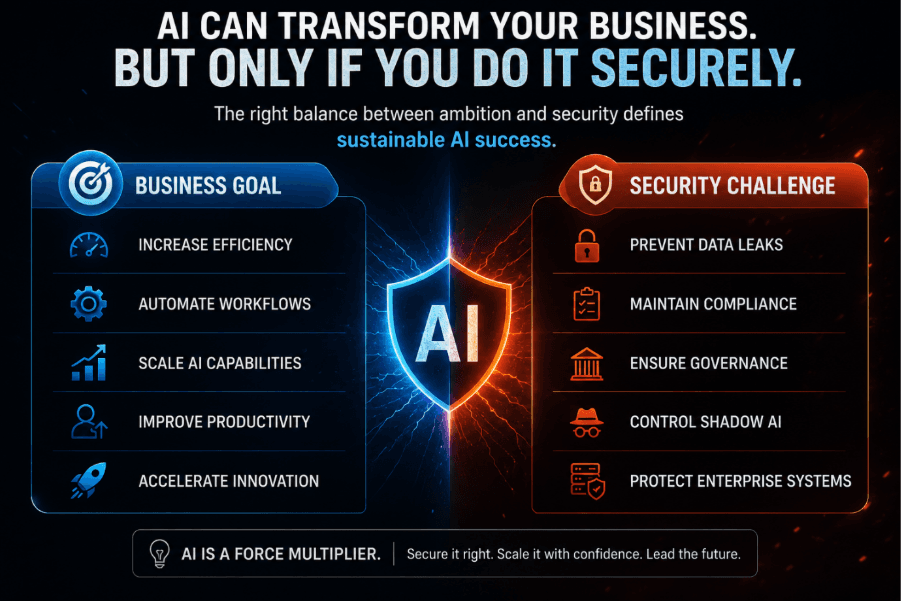
Organizations that delay putting AI guardrails in place often face bigger operational and compliance issues later.
A secure approach to AI helps organizations increase productivity without sacrificing trust or oversight.
What Secure AI Adoption Actually Means
Secure AI adoption is not about restricting AI usage.
It is about enabling AI responsibly while protecting business operations, data, and users.
A structured AI strategy combines:
- AI governance frameworks
- Cybersecurity controls
- Data privacy policies
- Compliance readiness
- Employee usage guidelines
- Access management systems
- Continuous monitoring and visibility
The goal is to create an environment where teams can use AI confidently without exposing the organization to unnecessary risk.
This approach helps businesses scale AI sustainably while keeping operations secure and manageable.
The 5 Core Pillars of Secure AI Adoption
1. AI Governance Must Be Established Early
One of the biggest mistakes organizations make is implementing governance after AI adoption has already spread across teams.
By then, Shadow AI has already become difficult to manage.
An effective AI governance framework defines:
- Approved AI platforms
- Acceptable use policies
- Data access permissions
- Compliance requirements
- Human review processes
- AI monitoring protocols
Without governance, AI systems become fragmented and inconsistent across departments.
Strong governance creates a scalable foundation for long-term AI transformation.
2. Data Protection Cannot Be an Afterthought
AI systems depend on data, which makes protecting enterprise data in AI workflows essential.
Many public AI tools process prompts externally, creating significant concerns around confidential information and intellectual property exposure.
Businesses must implement safeguards such as:
- Role-based access controls
- Data classification systems
- Encryption standards
- AI-specific DLP policies
- Secure enterprise AI environments
- Prompt monitoring and audit trails
These protections are especially critical in industries such as:
- Healthcare
- Financial services
- Consulting
- Manufacturing
- Retail and e-commerce
- Legal services
A single AI-related data breach can create financial losses, reputational damage, and regulatory penalties.
These measures reduce exposure while still allowing teams to use AI to work more efficiently.
3. Responsible AI Implementation Builds Trust
AI adoption is not just a technology challenge. It is a trust challenge.
Employees need confidence that AI systems are safe and reliable. Customers expect transparency around how their data is used. Leadership teams require visibility into AI-driven decisions.
This is where responsible AI implementation becomes critical.
Responsible AI focuses on:
- Transparency
- Fairness
- Explainability
- Human oversight
- Ethical deployment
- Bias mitigation
4. AI Security Risks Are Growing Rapidly
AI is changing cybersecurity on both sides.
Organizations are using AI to automate monitoring, threat detection, and operational workflows. Attackers are using AI to scale phishing attacks, impersonation campaigns, malware generation, and identity fraud.
Some of the most significant AI security risks include:
- Prompt injection attacks
- Data leakage
- Unapproved AI usage
- AI-generated misinformation
- Compliance failures
- Model manipulation
- Unauthorized integrations
- Identity vulnerabilities
This is why AI security cannot operate separately from enterprise cybersecurity strategy.
Businesses must secure AI ecosystems proactively instead of reacting after incidents occur.
5. Secure AI Adoption Drives Better Business Outcomes
Many businesses assume governance slows AI innovation.
In reality, the opposite is happening.
Organizations with structured AI governance are scaling faster because they reduce operational uncertainty, security gaps, and compliance friction early.
Secure AI adoption helps businesses:
- Automate workflows securely
- Reduce compliance and cybersecurity risk
- Improve employee confidence in AI usage
- Build stronger customer trust
- Scale AI initiatives with greater control
The Future of AI Belongs to Organizations That Build Securely
AI adoption is accelerating faster than most organizations anticipated.
This creates two clear paths forward:
- Adopt AI rapidly without governance and accumulate long-term risk
- Build secure AI foundations early and scale confidently
The second path creates sustainable growth.
Secure AI adoption is not about limiting innovation. It is about making innovation sustainable.
Organizations that balance productivity with protection will be better positioned to:
- Scale AI confidently
- Build stakeholder trust
- Reduce operational risk
- Improve compliance readiness
- Unlock long-term business value
The future will belong to organizations that treat AI security as a strategic business priority instead of an afterthought.
FAQ: Secure AI Adoption
What is secure AI adoption?
Secure AI adoption is the process of implementing AI tools and workflows in a way that protects sensitive data, supports compliance, and maintains operational control. It allows organizations to use AI productively without introducing unnecessary security or governance risks.
Why is AI governance important?
AI governance is important because it defines how AI tools are approved, monitored, and used across the organization. Clear governance helps reduce shadow AI, protects business data, supports regulatory compliance, and creates a more consistent foundation for scaling AI.
What are the biggest AI security risks for enterprises?
Common AI security risks include data leakage, prompt injection, unapproved tool usage, compliance failures, unauthorized integrations, and AI-generated misinformation. As AI becomes more embedded in daily work, these risks can affect data privacy, cybersecurity, and business continuity.
How can companies adopt AI securely?
Companies can adopt AI securely by setting clear usage policies, approving trusted AI platforms, applying access controls, protecting data in AI workflows, monitoring usage, and training employees on responsible AI practices. The goal is to make AI usable at scale without losing oversight.
Build a Secure AI Future with WinCap Consulting
If your organization is scaling AI without clear guardrails, now is the time to build a secure foundation. Successful AI transformation requires the right governance, visibility, and security from the start.
WinCap Consulting helps enterprises scale AI securely by aligning automation, governance, compliance, and cybersecurity. With the right strategy and safeguards, organizations can build AI ecosystems that support long-term growth with greater confidence.