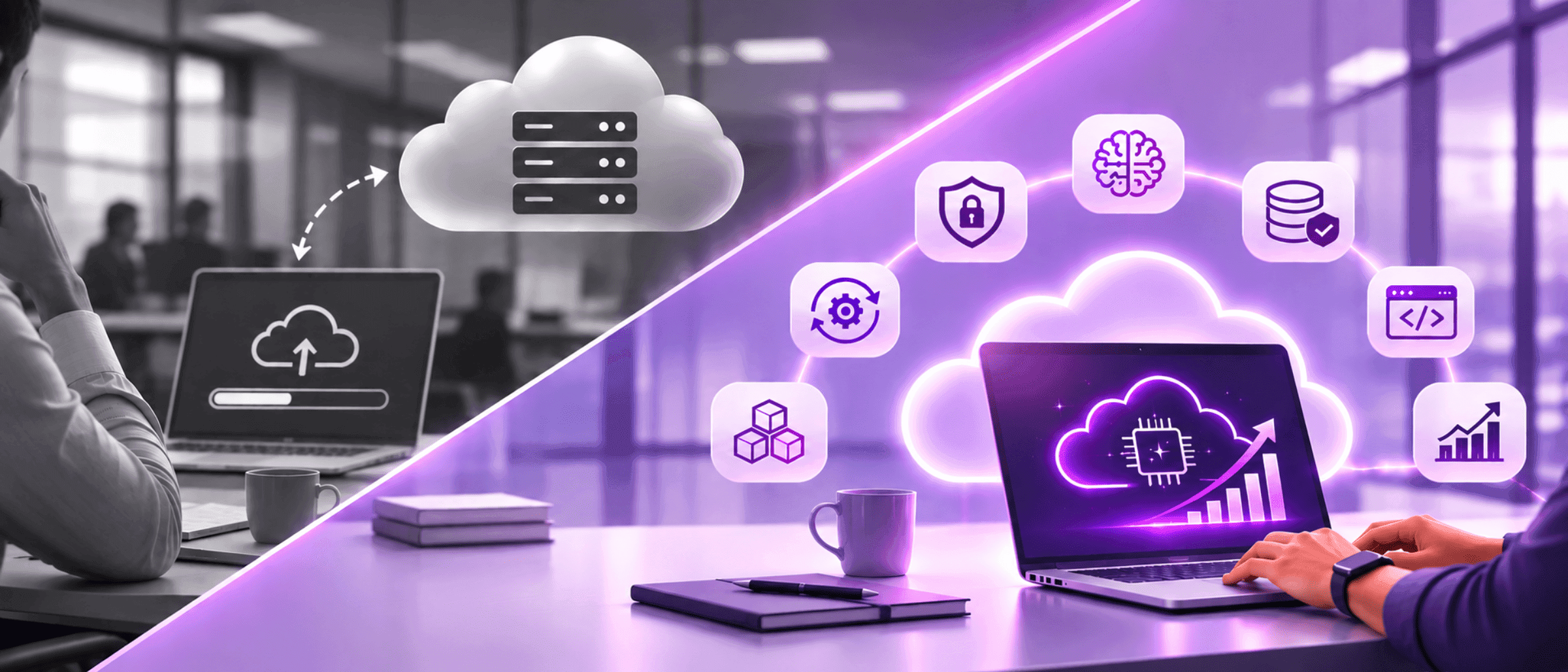
Cloud migration was only the first step. Discover why intelligent modernisation, connecting cloud, data, AI and security, is the new strategy for building an AI-ready enterprise.
Why Intelligent Modernisation Is the New Cloud Strategy
For much of the last decade, cloud transformation was largely defined by migration.
Technology leaders were tasked with moving applications, workloads and infrastructure out of traditional data centres and into the cloud. Success was measured by how quickly organisations could reduce their reliance on on-premises environments while gaining the scalability, flexibility and resilience that cloud platforms promised.
In many respects, the strategy delivered.
Organisations reduced infrastructure overheads, accelerated deployment cycles and gained access to capabilities that would have been difficult and expensive to build internally. Moving to the cloud became a critical step in modernising enterprise technology and creating a foundation for future innovation.
Yet for many organisations, a surprising reality has emerged.
Despite significant investments in cloud migration, the business outcomes they expected have not always followed. Infrastructure may be modern, but operations often remain complex. Applications now run in the cloud, yet innovation still progresses more slowly than expected. Organisations have access to more data than ever before, but decision-making frequently remains fragmented across teams, platforms and business units.
As organisations look to unlock the value of artificial intelligence, automation and modern digital experiences, many are discovering that migration alone was never the end goal. It was simply the first stage of a much broader transformation journey.
This is why forward-thinking organisations are shifting their focus away from lift-and-shift strategies and towards a more holistic approach: intelligent modernisation.
The Challenge with Treating Cloud as the Destination
When cloud adoption first accelerated, many organisations understandably prioritised speed. The objective was to exit ageing infrastructure, reduce operational complexity and establish a cloud presence as efficiently as possible.
The challenge is that migration projects often focused on where technology was running rather than how the business was operating.
As a result, organisations frequently carried longstanding inefficiencies into their new environments. Legacy applications continued to support outdated processes, data remained distributed across multiple systems, and teams still relied on manual workarounds to accomplish tasks that should have been automated years earlier.
The cloud provided a more flexible and scalable foundation, but it did not automatically eliminate the structural issues that had accumulated over time.
This distinction has become increasingly important. Business leaders today are less interested in whether workloads have been migrated and more interested in whether technology investments are creating measurable business value. They want faster decision-making, greater operational efficiency, stronger security, improved employee productivity and the ability to respond quickly to changing market conditions.
Achieving those outcomes requires more than cloud migration. It requires cloud modernisation.
Why AI Has Changed the Conversation
Few technology trends have reshaped executive priorities as dramatically as artificial intelligence.
Across every industry, organisations are exploring how AI can improve productivity, elevate customer experiences and create entirely new opportunities for growth. Boardroom conversations that once centred on cloud adoption are now increasingly focused on AI readiness, data strategy and transformation outcomes.
However, many organisations are discovering that AI quickly exposes weaknesses that remained hidden during migration programmes.
Data becomes difficult to leverage when information is fragmented across multiple platforms. Governance concerns emerge when ownership of critical data assets is unclear. Security risks become more pronounced when organisations attempt to deploy AI without the right controls and oversight mechanisms in place.
In many cases, the limiting factor is not the AI technology itself. It is the environment surrounding it.
Successful AI adoption depends on having secure, governed and accessible data. It requires modern applications that integrate effectively with emerging technologies. It depends on streamlined business processes and employees who are equipped to work confidently alongside intelligent tools.
Organisations that have invested in cloud modernisation and data modernisation are often progressing faster because they have already strengthened the foundations required for AI success. Those that have not are finding their ambitions constrained by legacy decisions, fragmented systems and outdated operating models.
Modernisation Has Become a Business Imperative
One of the most significant changes over the past several years is that modernisation is no longer viewed solely as an IT initiative.
Historically, transformation programmes were measured through technical milestones such as migration completion, infrastructure consolidation or application upgrades. While these achievements remain important, they no longer tell the complete story.
Today, modernisation is increasingly tied to broader business objectives.
Leadership teams are evaluating technology investments based on their ability to improve customer experiences, increase workforce productivity, strengthen organisational resilience and support long-term growth. Technology decisions are being assessed through the lens of business outcomes rather than technical completion.
This shift requires organisations to think differently about transformation.
Rather than pursuing isolated projects, organisations must consider how cloud, data, AI, security and automation work together to create meaningful business value. The focus moves from implementing technology to building organisational capability.
That is the essence of intelligent modernisation.
Building the Foundations of an Intelligent Enterprise
At its core, intelligent modernisation is about creating an environment where technology continuously enables improvement.
It starts with a modern cloud foundation, but cloud modernisation extends far beyond infrastructure.
Data must be accessible, trusted and governed so that employees can make informed decisions and AI solutions can generate meaningful outcomes. Security must be integrated across every layer of the organisation, protecting users, applications and information without creating unnecessary barriers to productivity. Business processes must be simplified and automated wherever possible so that teams can focus their efforts on higher-value work.
Equally important is the employee experience.
Modern employees expect seamless access to information, collaboration tools and digital services. They want technology that helps them work more effectively rather than introducing additional complexity. Organisations that invest in modern digital workplaces are often better positioned to improve productivity, accelerate innovation and support more agile ways of working.
When these elements come together, cloud modernisation becomes far more than a technology programme. It becomes a mechanism for continuous business improvement.
Why Security and Resilience Must Be Part of the Strategy
As organisations modernise, they also face a threat landscape that is more complex than at any point in recent history.
Cybersecurity can no longer be considered separately from transformation. Every cloud service, application integration, AI deployment and digital workplace initiative introduces new considerations around identity, data protection and operational resilience.
The most successful organisations recognise this reality by embedding security into their transformation strategies from the outset. Rather than viewing security as a checkpoint at the end of a project, they build it into architecture decisions, governance frameworks and operational processes.
This approach not only reduces risk but also creates confidence. It enables organisations to innovate more quickly because compliance, security and resilience are integrated into the foundation of the environment.
In an era where cyber resilience and business continuity are board-level priorities, this capability is becoming a significant competitive advantage.
Transformation Is No Longer a Project
Perhaps the most important lesson organisations have learned over the past decade is that transformation does not have a finish line.
Technology continues to evolve. Market expectations continue to shift. New opportunities emerge while existing business models face disruption. What feels modern today may feel outdated in just a few years.
The organisations that thrive in this environment have stopped treating transformation as a one-time initiative.
Instead, they are building cultures and operating models that embrace continuous improvement. They modernise, optimise, secure and innovate as an ongoing process rather than a sequence of disconnected projects.
This mindset creates a powerful advantage.
Rather than periodically reacting to change, these organisations become inherently adaptable. They are better positioned to adopt emerging technologies, respond to shifting market conditions and unlock new sources of value because cloud modernisation is embedded into the way they operate.
The Future Belongs to Intelligent Modernisers
The cloud era fundamentally changed how organisations think about technology. It provided the foundation for agility, scalability and innovation on a scale that was previously difficult to achieve.
Yet the next phase of transformation will be defined by something more ambitious.
Success will not be determined by how many applications have been migrated or how much infrastructure has been moved. It will be determined by how effectively organisations connect cloud, data, AI, security and people into a cohesive strategy that delivers continuous business value.
This is why the conversation is evolving beyond lift-and-shift.
Cloud migration remains important, but it is no longer the destination. It is the starting point. The organisations creating lasting competitive advantage are those using that foundation to modernise processes, improve experiences, strengthen resilience and unlock the full potential of data and AI.
In a world increasingly shaped by intelligent technologies, the question is no longer whether organisations have moved to the cloud. The real question is whether they are prepared to fully capitalise on what the cloud makes possible.
That is the difference between migration and modernisation.
And it is where the next generation of business leaders will separate themselves from the rest.
Where Does Your Organisation Stand?
Most organisations have already completed some form of cloud migration. Far fewer have evaluated whether their existing environment is truly ready for what comes next.
As AI adoption moves from experimentation to business reality, technology leaders are increasingly asking difficult questions about data readiness, security, governance, operational efficiency and workforce productivity. The answers often reveal that modernisation opportunities extend far beyond infrastructure.
WinCap helps organisations identify those opportunities and develop practical roadmaps that connect cloud, data, AI, security and workplace transformation to measurable business outcomes. By aligning technology decisions with business priorities, organisations can achieve more than operational efficiency. They can create a foundation for innovation, resilience and sustainable growth. As a Microsoft and AWS partner, WinCap brings deep platform expertise across both ecosystems, making us the partner to turn to for all your modernisation needs.
Ready to move beyond cloud migration?
WinCap helps organisations assess AI readiness, modernise cloud environments, strengthen cyber resilience and build transformation roadmaps aligned to measurable business outcomes. Whether your priority is optimising existing cloud investments or preparing for the next phase of AI adoption, our team can help you turn cloud modernisation into lasting business value. As a trusted Microsoft and AWS partner, we are your go-to partner for every stage of modernisation.
Start a conversation with WinCap about your cloud modernisation journey.
Frequently Asked Questions on Cloud Modernisation
1. Where should an organisation start with cloud modernisation?
Most organisations begin with an assessment of their current cloud environment, covering applications, data, security posture and operating model. This highlights which workloads deliver the most value if modernised first and helps shape a phased roadmap.
2. Can cloud modernisation be done without disrupting day-to-day operations?
Yes. A phased approach, where applications and data platforms are modernised in stages and tested before cut-over, helps keep critical services running while improvements are introduced gradually.
3. How can organisations measure the success of cloud modernisation?
Success is best measured against business outcomes rather than technical milestones. Common indicators include faster release cycles, lower operating costs, improved system performance and availability, stronger security posture and higher employee productivity.
4. Which applications should be prioritised for modernisation?
Priority usually goes to applications that are business-critical, costly to maintain, difficult to integrate with data and AI services, or exposed to security and compliance risk. Low-impact applications can follow in later phases.
5. How can WinCap help with cloud modernisation?
As a Microsoft and AWS partner, WinCap helps organisations assess AI readiness, modernise cloud environments, strengthen cyber resilience and build transformation roadmaps aligned to measurable business outcomes.