.png&w=3840&q=75)
This guide explains six cloud migration mistakes that continue to slow enterprise transformation and shows what successful organizations do differently to reduce risk, control cost, strengthen governance, and create value after migration is complete.
Some of the most expensive cloud migration mistakes do not look like mistakes at first. Projects stay on schedule, budgets appear controlled, applications go live, and stakeholders celebrate another migration milestone. The problems usually surface later, when cloud costs rise faster than expected, governance becomes inconsistent, underutilized resources accumulate, and applications behave differently in production than they did during testing.
Cloud migration doesn't always fail dramatically. Sometimes it succeeds just enough to delay the real problems until they're far more expensive to solve. This is why cloud migration remains one of the most misunderstood enterprise initiatives in 2026. Success isn't determined by how quickly workloads move to the cloud. It's determined by what happens after they get there.
Organizations that consistently realize the greatest value from enterprise cloud migration don't simply execute migrations well. They approach planning, governance, security, modernization, and optimization as one connected strategy rather than a series of independent projects.
This guide explains six cloud migration mistakes that continue to slow enterprise transformation and shows what successful organizations do differently to reduce risk, control cost, strengthen governance, and create value after migration is complete.
What You’ll Learn About Enterprise Cloud Migration
Every enterprise cloud migration is different, but the patterns behind delayed, over-budget, or underperforming migrations are surprisingly familiar.
Whether you are preparing for your first migration, modernizing an existing cloud environment, or optimizing workloads that have already moved, these six lessons will help you avoid decisions that increase costs, add operational complexity, and delay business outcomes. More importantly, they will help you build a cloud migration strategy that continues creating value long after migration is complete.
Use these six cloud migration mistakes as a practical checklist before approving a migration roadmap. Each one points to a decision that should be made before execution begins, not after cloud costs, governance gaps, or performance issues have already appeared.
Mistake #1: Treating Every Workload Like It Belongs in the Cloud
Cloud migration often begins with a simple objective.
Move everything. It sounds efficient. If the organization has already made cloud adoption a strategic priority, migrating every workload can seem like the most straightforward path forward. In practice, that's rarely the best decision.
Enterprise environments are built over years, sometimes decades. Some applications support critical business operations. Others exist because replacing them has never been a priority. Some can be modernized. Others perform perfectly well where they are. Treating every workload as though it requires the same migration approach ignores those differences and often creates unnecessary complexity.
One of the biggest misconceptions about cloud migration services is that migration itself creates value. It doesn't. Value comes from making informed decisions about what should be rehosted, refactored, retired, retained, or replaced. Those decisions are impossible without first understanding how each workload supports the business.
Organizations that invest time in a structured Cloud Readiness Assessment may not always migrate faster, but they make better migration decisions. They can identify which workloads should move, which should be modernized first, and which may deliver more value if retained, retired, or replaced.
Why it matters
A workload-first approach reduces migration risks, improves application performance, and helps organizations prioritize investments where cloud adoption delivers measurable business value instead of simply increasing infrastructure costs.
A Better Approach
Rather than asking, "What's the fastest way to migrate this workload?"
They ask "Should this move at all, and if it does, what's the right migration approach?"
The challenge is not simply deciding what to migrate. The real challenge lies in understanding the relationships between applications, users, processes, data flows, and business outcomes before any migration activity begins.
Mistake #2: Underestimating Application Dependencies
Most enterprise applications don't work alone.
Customer portals depend on authentication services. Finance systems exchange data with reporting platforms. Manufacturing applications connect to legacy databases that have quietly supported operations for years. Remove one dependency, and several others suddenly become visible.
On paper, migration plans often treat applications as individual workloads. The business doesn't.
Every application supports people, processes, integrations, and decisions that extend well beyond the infrastructure hosting it. Missing even a single dependency can affect testing timelines, migration sequencing, and business continuity in ways that are difficult to predict once execution has started.
Dependency mapping isn't usually the most visible part of a migration program, but it's often the difference between a migration that follows the plan and one that spends weeks adapting to unexpected issues.
Understanding how systems interact before migration begins gives project teams the confidence to migrate in logical phases instead of reacting to problems after they've already appeared.
Why it matters
Comprehensive dependency mapping reduces unplanned downtime, improves migration sequencing, and minimizes disruption to business-critical operations during cloud transformation.
A Smarter Way Forward
Rather than inventorying servers, they map business services. That shift changes the entire migration strategy because decisions are based on business continuity rather than infrastructure alone.
Mistake #3: Waiting Until After Migration to Think About Governance
Cloud governance often arrives too late.
Migration planning discussions often concentrate on timelines, deployment phases, infrastructure requirements, and application dependencies. Governance is pushed further down the agenda because it doesn't appear urgent while workloads are still being moved.
The problem only becomes visible after migration.
Different teams begin creating resources in different ways. Naming conventions vary across projects. Permissions become inconsistent. Budgets are managed differently between departments. Within months, what looked like a well-organized cloud environment becomes increasingly difficult to control.
Cloud governance isn't about introducing more policies. It's about creating consistency before scale makes consistency impossible.
A strong Cloud Adoption Framework establishes standards for identity, security, networking, resource organization, cost ownership, and compliance before the first production workload reaches the cloud. When governance is built into the migration strategy from the beginning, organizations spend less time fixing inconsistencies later.
Why it matters
Early governance improves security, simplifies operations, and creates a cloud environment that remains manageable as adoption grows.
A More Effective Approach
Governance isn't introduced after migration.
Governance should be designed alongside the migration roadmap so every deployment follows the same operational standards from day one. This prevents cost, access, security, and compliance decisions from becoming harder to control after workloads are already running in the cloud.
Mistake #4: Believing Cloud Migration Automatically Lowers Costs
One of the most persistent misconceptions about cloud migration is that moving workloads automatically reduces costs.
Sometimes it does. Often, it doesn't.
The cloud makes it remarkably easy to provision new infrastructure. The same flexibility that allows organizations to scale quickly can also lead to unused resources, oversized virtual machines, duplicate environments, and services that continue running long after they're needed.
These costs don't usually appear overnight. They accumulate gradually.
A development environment that is never switched off, storage that grows without lifecycle policies, and applications sized for peak demand instead of actual usage can each look minor in isolation. Together, they can turn a technically successful migration into a cloud estate that costs more to run than expected.
Cloud cost optimization should influence workload design, architecture decisions, resource sizing, and operational governance from the beginning.
Why it matters
Continuous cost optimization helps organizations maximize cloud investments, improve financial visibility, and ensure infrastructure spending aligns with actual business demand.
A Better Way to Manage Cloud Costs
Build cloud cost monitoring, ownership, and optimization into the operating model from the beginning so teams can track usage, eliminate waste, and align cloud spend with business demand.
Mistake #5: Measuring Migration Success Too Early
Cloud migration projects are often declared successful the day production workloads go live, but that milestone only proves the move happened. It does not prove the cloud environment is delivering better performance, stronger resilience, improved security, or lower operating costs.
Migration milestones are important.
Applications are running. Users can access systems. Downtime has been avoided. From a delivery perspective, that's a success. From a business perspective, the real evaluation is only beginning.
Cloud migration should improve more than infrastructure.
It should enable faster releases, stronger resilience, better scalability, improved security, simplified operations, and lower operational costs over time. None of those outcomes can be measured during migration weekend.
Organizations that continue measuring cloud performance after migration are better positioned to identify optimization opportunities, improve resource utilization, and refine their operating model. Those that stop measuring once workloads have moved often struggle to explain whether migration delivered the business value that justified the investment.
Migration is an important milestone. It's not the finish line.
Why it matters
Long-term success depends on tracking business outcomes, operational efficiency, application performance, security posture, and cloud costs long after migration has been completed.
A Better Measure of Success
Instead of celebrating the migration itself, successful organizations measure what the migration enables over the following months: application performance, release speed, resilience, security posture, user experience, cloud cost trends, and operational efficiency. Those insights then guide continuous optimization of the cloud environment.
A successful migration doesn't end when workloads reach the cloud.
The next challenge is ensuring the cloud environment continues to evolve alongside the business rather than becoming another platform that gradually accumulates technical debt.
Mistake #6: Viewing Cloud Migration as a Technology Project Rather Than a Business Transformation
One of the biggest misconceptions about cloud migration is that it's primarily a technology project.
The technology is certainly important, but successful migrations are rarely determined by infrastructure alone. They're influenced by how quickly business teams adapt to new ways of working, how operational processes evolve, and whether people understand the changes happening around them.
It's surprisingly common for organizations to complete a technically successful migration while continuing to operate exactly as they did before. Development teams follow old release processes. Operations teams continue using manual provisioning. Business units remain disconnected from cloud cost decisions. The platform changes, but the operating model doesn't.
That's where much of the promised value quietly disappears.
Cloud transformation isn't simply about changing where applications run. It's about changing how technology enables the business. That requires collaboration between IT, finance, security, operations, and business leaders long before migration begins and long after it's completed.
Why it matters
Organizations that treat cloud migration as a business transformation rather than an infrastructure project are better positioned to improve agility, accelerate innovation, and maximize long-term cloud investments.
The Better Operating Model
Technology teams don't own cloud migration alone.
Business leaders, finance teams, security, operations, and application owners remain involved throughout the transformation journey.
What Successful Cloud Migrations Have in Common
Looking across successful migration programs, one pattern appears repeatedly.
Organizations that achieve the best migration outcomes succeed not because they rely on better technology alone, but because they make informed decisions throughout the transformation journey.
They move with greater confidence because they make clearer decisions before, during, and after migration: what should move, how it should be governed, who owns cost, how success will be measured, and how the environment will continue improving.
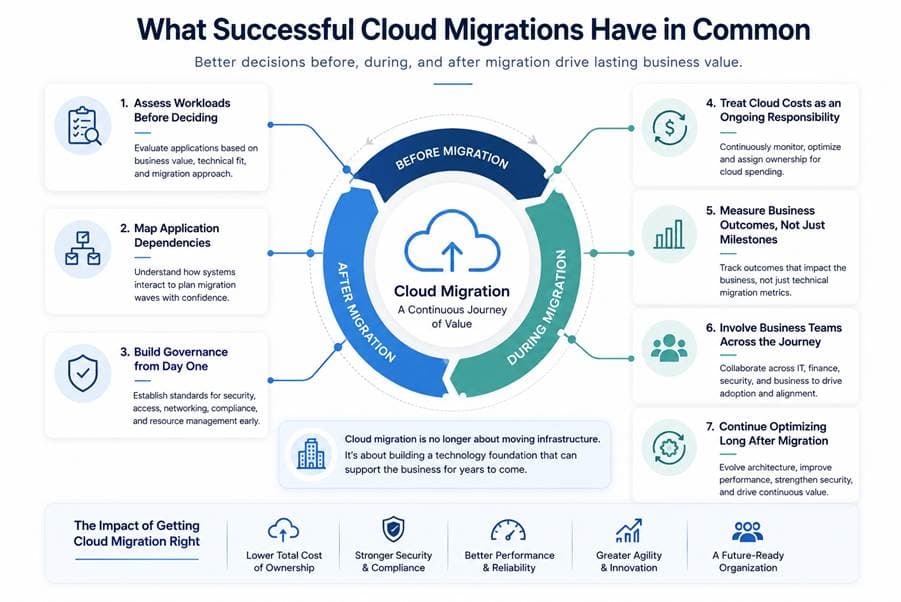
The real lesson is simple: cloud migration succeeds when it is planned as a business transformation, not a workload movement exercise. The strongest programs make decisions about readiness, dependencies, governance, cost, success metrics, and ownership before migration begins, then keep optimizing long after the first workloads go live.
Ready to Build a Stronger Cloud Migration Strategy?
A successful cloud migration isn't defined by how quickly workloads move.
It's defined by how well your cloud environment performs long after migration is complete.
At WinCap, we help enterprises design, execute, and optimize cloud migrations that improve performance, strengthen governance, control cloud costs, and create a foundation for long-term growth. From readiness assessments and migration planning to architecture design, workload modernization, governance, and post-migration optimization, our specialists work alongside your teams to reduce risk at every stage.
Build a cloud environment that's secure, scalable, and designed to deliver measurable business value from day one.
Talk to a Cloud Migration Expert
Frequently Asked Questions on Enterprise Cloud Migration
1. How long does cloud migration take for an enterprise?
Enterprise cloud migration timelines depend on the number of applications, workload complexity, data volume, integrations, compliance requirements, and testing needs. A small migration may take a few weeks, while a large enterprise migration is usually planned in phases over several months.
2. How much does cloud migration cost?
Cloud migration cost varies based on scope, application complexity, migration approach, data transfer, security requirements, compliance needs, and post-migration optimization. Enterprises should estimate both one-time migration costs and ongoing cloud run costs before approving the roadmap.
3. What are the first steps in planning a cloud migration?
The first steps are to define business objectives, assess application readiness, map dependencies, identify security and compliance requirements, estimate costs, and choose the right migration approach for each workload. This planning stage helps prevent delays, budget overruns, and operational disruption later.
4. Which workloads should not be moved to the cloud?
Not every workload should move to the cloud. Applications with low business value, unsupported legacy dependencies, strict latency needs, unresolved compliance constraints, or limited modernization potential may be better retained, retired, replaced, or redesigned before migration.
5. How does cloud modernization differ from cloud migration?
Cloud migration is the process of moving applications, data, or infrastructure to the cloud. Cloud modernization goes further by improving applications, architecture, automation, security, scalability, and operating models so the business can gain more value after migration is complete.
6. Do businesses need a cloud migration partner?
A cloud migration partner can help when the environment is complex, regulated, resource-constrained, or business-critical. The right partner supports assessment, planning, architecture, migration execution, governance, cost optimization, and post-migration improvement so internal teams can reduce risk and move with greater confidence.